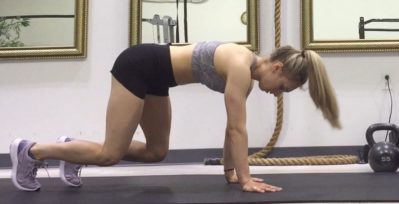
Bear Crawl
The bear crawl is one excellent exercise you are not doing!
In this post, we will discuss benefits of this exercise, how to perform it and some other similar exercise variations.
Bear Crawl Exercise Benefits
This movement is simple to do, and it does not require any equipment besides your own body. You can do it at home, at your hotel room, at the track, or anywhere else.
Here are some benefits specific to the bear crawl exercise.
- Boost Agility
- Boost Core Strength
- Boost Upper Body Strength
- Train your Brain
- Abdominals
- Obliques
- Lower Back
- Upper Back
- Shoulders
- Chest
- Hip Flexors
- Quads
- Glutes
- Serratus Anterior
Let’s discuss each of these benefits in a bit more detail.
Boost Agility
The bear crawl boosts agility and coordination. This exercise is perfect for dancers, gymnasts and other athletes who need good coordination and body awareness. It is one exercise that you could probably do as a kid but need to relearn as an adult.
Boost Core Strength
The bear crawl will also improve your core strength and endurance! Additionally, it will improve your ability to maintain good core positions for distance and time.
This movement requires you to move with a neutral spine and pelvis. This is awesome because many people struggle keeping a neutral spine while moving through the arms and legs. Learning how to stabilize your spine in the “all fours” bear crawl position can translate to other athletic movements.
Boost Upper Body Strength
The bear crawl also prevents you from slacking off through your shoulders and upper back. You have to maintain good alignment through the shoulders to do this exercise.
This makes this exercise a great drill to boost shoulder strength and endurance.
Train your Brain
Learning new fitness skills is good for your brain. When you move alternating arms and legs in unison, your brain has to work to coordinate the movement. Learning complex movements and skills can help strengthen new neural pathways and may even help prevent dementia in old age.
Now that we discussed the benefits, let’s talk about the muscles worked in the bear crawl.
Bear Crawl Muscles Worked
The bear crawl works a lot of muscles in unison.
This simple movement challenges many different muscle groups to work together.
Are Bear Crawls Better than Push ups?
Bear crawls are different than push ups. They certainly work your core, chest and shoulders just like push ups. However, to build a strong chest and upper body, you still need to do push ups and other chest exercises.
Consider bear crawls a fun core exercise to include at the end of your workout that involves a bit of chest strengthening too, but do not substitute it for your bread and butter strength work.
Are Bear Crawls Bad for your Back?
Bear crawls are good for your back.
They force you to keep a neutral spine and learn good spinal mechanics. This exercise also de-loads your spine and strengthens your core. All these attributes make bear crawls great for your back.
The key is to keep your back straight, hips square and to maintain some tension in your core. Always remember that quality comes before quantity, so aim to keep your bear crawls perfect before advancing to longer distances or new challenges to keep any pain at bay.
Bear Crawl Variations
Here are some excellent bear crawl exercises.
Forward Bear Crawl
To do the forward bear crawl, start with hands under shoulders, knees under hips, back flat and hips square. Keep hips level with shoulders and head in a neutral position throughout.
Take small steps with left hand and right foot at the same time, and then coordinate movement through the right hand and left foot.
Continue alternating steps. Your back and hips should remain square. If you put your phone on your back, you should be able to keep it there!
Backwards Bear Crawl
The backwards bear crawl is the same as the forward bear crawl with one key difference: it is performed backwards!
Sideways Bear Crawl
With the sideways bear crawl, you will set the same position up with knees under hips and hands under shoulders. You will need to take steps with same hand and foot simultaneously instead of alternating sides.
Dumbbell Bear Crawl
Set up in the traditional bear crawl position with hands positioned over dumbbells.
Perform bear crawls normally, lifting weights with hands as you go. Make sure you keep back straight and hips square as before.
Crab Walk
Place hands below shoulders, with hands facing forward. Place feet under knees. Lift hips up and walk with alternating hands and feet forward or backwards.
Slider Walks
Get into a push up position with feet on sliders. Make sure you assume a good shoulder position. With feet still, step with alternating hands for distance. Keep back flat throughout.
Incorporating the Bear Crawl into your Workouts
Perform your bear crawls during your warm ups. You can also perform this exercise at the end of your workout. I would recommend two or three sets of about 8-20 steps per hand. Rest one or two minutes between sets.
Final Thoughts
What are your thoughts on the bear crawl? Do you perform this exercise in your workouts? Please let me know in the comment section below.
