Differences between Powerlifting vs. Weightlifting
Powerlifting and weightlifting are two of the most popular strength sports. However, many people fail to grasp the differences between powerlifting vs. weightlifting.
In this post, we will define powerlifting and weightlifting and outline the differences between the two. We will also discuss why the two terms are often wrongly used interchangeably in American sports culture.
What is Powerlifting?
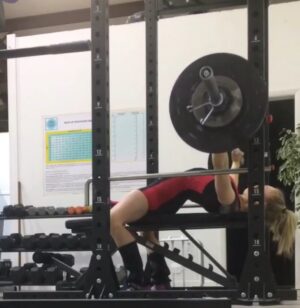
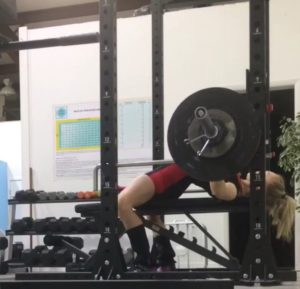
Powerlifting is a sport that tests strength in three disciplines: the barbell back squat, the barbell bench press and the barbell deadlift, completed in that order in a competition. Athletes must successfully complete their lifts according to the standards of their competition organization. 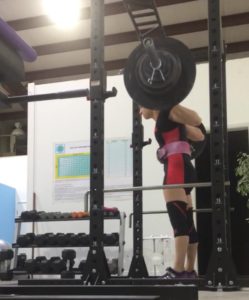
Power lifters aim to lift the most weight in each category to build the strongest total weight across the three disciplines. Lifters are grouped by sex and weight class in competition so that smaller lifters have an equal chance against larger lifters. Totals are standardized based on relative strength using the Wilks Coefficient. The lifter with the best Wilks Coefficient wins the competition.
While the sport is not in the Olympics, competitors can compete on the local, state, national and international level. Within the United States, there are numerous powerlifting federations. Some of the federations are rigorously drug tested (cheating may still occur), while others provide open competition for people without drug testing.
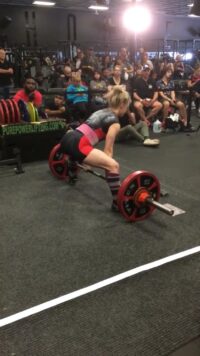
Lifters get three attempts at each lift to build their total. If a lifter misses a lift, they can either repeat the same weight or increase the next attempt by 2.5 kilograms or more. Because lifters cannot reduce the weight on the bar with subsequent attempts, attempt selection plays a big role in a powerlifter’s game day strategy.
What is Weightlifting?
Weightlifting is the sport of Olympic weightlifting. The sport consists of two lifts: the barbell snatch and the barbell clean and jerk, completed in that order. Competitors are given three attempts at each movement to build the highest total. Lifts must be successfully performed according to the standards set by the International Weightlifting Federation.
Weightlifters are grouped by weight class and sex to compare weightlifters of different sizes. Each total is standardized relative to the athletes’ weight using the Sinclair Coefficient. The weightlifter with the highest Sinclair Coefficient wins the competition.
Weightlifters cannot reduce the weight on the bar after a successful or a missed lift. They must keep the same weight or increase by 1 kilogram or more for the next lift. Proper attempt selection is just as important in weightlifting competitions as in powerlifting and helps lifters maximize their total.

While powerlifting athletes can often successfully grind through and complete a lift that is not technically perfect, that’s much harder to do in weightlifting. A form error can easily result in a missed lift due to the dynamic nature of the weightlifting movements.
Training Differences
While powerlifting and weightlifting are both strength sports, these athletes train differently to achieve their goals.
Powerlifters often concentrate their training around the back squat, bench press and deadlift. However, accessory work can help athletes improve technique and strength in those lifts. Sample accessory movements include pause or tempo squats and deadlifts, tempo bench presses, and general strength exercises.
Muscle Hypertrophy
A significant amount of training time is also devoted to muscle hypertrophy, or muscle growth, since bigger muscles can produce more force. Ideally, lifters choose a weight class where they can maximize their muscle mass and maintain the best competitive advantage. Because muscle growth is a significant component of powerlifting, many power lifters also cross compete in bodybuilding in the off-season.
In weightlifting, muscle hypertrophy is less important than in powerlifting. Athletes spend their training time focused on improving their snatch and clean and jerk. Additionally, because the snatch and clean and jerk are quick and involve little time under tension, they don’t build as much muscle as the powerlifting movements.
Leg Strength and Power for Weightlifing
Because weightlifting mainly focuses on lower body strength and power, weightlifters also train the back squat and front squat a lot. Weightlifters often build incredible squat strength and rival powerlifters at the squat. Overhead strength and stability are also important for weightlifting. Exercises like overhead presses, push presses, handstands, overhead holds and overhead squats serve as good accessory movements for weightlifting.
Many weightlifters do not train the bench press much at all. The bench press often restricts shoulder mobility needed for the overhead positions in weightlifting. Some weightlifters perform clean deadlifts to build strength for cleans.
Weightlifting also produces and requires more power than powerlifting. Thus, it’s common for weightlifters to train power exercises like box jumps, depth jumps, sprints, hops, weighted throws and other plyometric exercises. These exercises carry over to the snatch and clean and jerk.
Why do people mix these sports up?
Why do so many people fail to grasp the differences between these two sports? Perhaps because powerlifting is a misnomer for a sport that primarily tests strength, rather than power. Maybe weightlifting is wrongly called powerlifting because it involves significant muscular power and speed.
Additionally, powerlifting and weightlifting are still niche sports. Many people don’t even know they exist, let alone the intricate details of each activity. While both sports have experienced significant growth in the last two decades, they still draw fewer participants than many more mainstream sports. Additionally, American Olympic weightlifters have lagged behind Chinese and Soviet System weightlifters at the international and Olympic stages. Unlike in the U.S, those countries have centralized weightlifting coaching that begins for kids at very young ages.
Final Thoughts
While both strength sports, powerlifting and weightlifting are vastly different strength sports that share a few similarities. While powerlifters focus on maximal strength in the squat, bench press and deadlift, weightlifters focus on building the heaviest snatch and clean and jerk for competition. The training and speed and power demands for each sport are also different. Powerlifting involves higher absolute force production, while weightlifting involves slightly less absolute force production but more power production. While one sport is only moderately technical, the other is extremely technically demanding to the point where minor errors can result in a missed lift.
However, both sports build and test strength and power and award the athlete who lifts the most weight relative to body weight. Both activities (whether pursued competitively or simply as training tools) are also a fantastic way to build strength, self-confidence, and mental toughness.
